At Tower View Acres in Mount Calvary, Wisconsin, dairy producer Jason Baus believes ideal feeding started with understanding his cows. “Cows aren’t on our schedule,” Baus said. “They’re on their own. Our job was to make sure the right feed is there whenever they are ready to eat.”
That philosophy guided the evolution of his family’s operation from traditional feeding methods to a highly automated, precision-based system designed around cow comfort, consistency, and performance with a Lely Vector automatic feeding system.
Together with Joel Eberhart, Lely North America Feed and Manure Product Specialist, and Dan Schreiner, Lely North America Feed and Manure Product Manager, Baus shared how his family operation has embraced automatic feeding in a Lely LIVE Webinar on Ideal Feeding.
From Family Farm to Automation
Tower View Acres is a multigenerational dairy rooted in hard work and adaptability. “My dad loved cows. My mom went along with him,” Baus said. “I grew up on the farm, but I didn’t always know if I wanted to milk cows twice a day forever.”
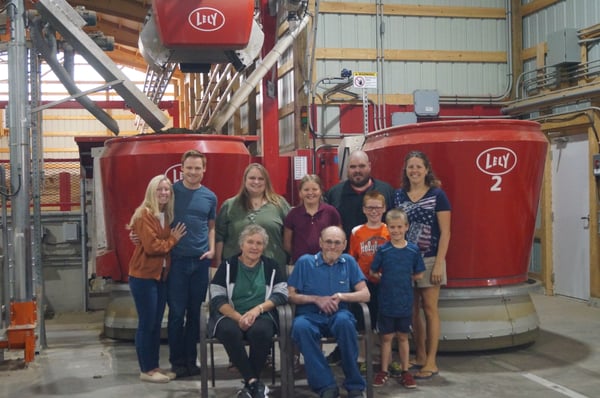
In 2016, the farm took its first major step into automation with three Lely Astronaut A4 automatic milking systems. Around the same time, Baus began exploring automated feeding.
“I loved the idea of feeding to the need and having fresh feed all the time,” he said. “But at first, we weren’t sure if it made sense for us.”
With strong production already in place, harvesting roughly 7,000 pounds of milk per robot and maintaining a rolling herd average near 100 pounds, Baus questioned how much more improvement was possible.
After several years of research and planning, Tower View Acres installed the Lely Vector automatic feeding system in 2021.
“Looking back, it all made sense,” he said. “But at the time, it was a big decision.”
Defining Ideal Feeding
For Baus, ideal feeding was about consistency and timing.
“It was making sure each cow got fresh, balanced feed when she wanted it, not when we decided,” he explained.
Schreiner agreed with that. “Ideal feeding is the right ration, to the right cows, 24/7,” Schreiner said. “Every farm has different challenges, but that principle stays the same.”
Eberhart added that modern feeding systems aimed to mirror natural behavior. “Each cow is designed to eat throughout the day,” he said. “Our goal was to make sure the feed at 2 a.m. is the same quality as the feed at 3 p.m.”
Before automation, Tower View Acres fed once per day.
“We’d feed in the morning, everybody would rush to the bunk, and by night the feed was picked over,” Baus said.
With automated feeding, the herd receives fresh feed approximately 12 times per day across four main feeding groups.
“It completely changed cow behavior,” he explained. “They didn’t have to get up and rush anymore. Feed is always coming.”
During heat stress, the system adapts automatically.
“They eat more at night when it is cooler,” Baus said. “The system adjusts, and the feed is fresh when they want it.”
As a result, Tower View Acres saw minimal drops in dry matter intake during summer months. “They are still eating,” Baus said. “Just at different times.”
Using Data to Fine-Tune Nutrition
One of the biggest advantages of automated feeding is access to real-time data.
With detailed tracking of feed delivery, intake, and group performance, Baus analyzes dry matter intake by pen and age group.
“I can see younger cows eating 56 pounds and older cows eating 63,” he explained. “We were able to dial in rations and save on protein where it made sense.”
His nutritionist also benefits from the data.
“We are making decisions based on facts, not guesses,” Baus said.
Eberhart noted that data allows producers to intervene early.
“If intake drops, it was often the first sign of a problem,” he said. “You can respond before milk suffers.”
Better Rumen Health, Better Production
More frequent feeding also improves rumen stability. By avoiding large starch and intake swings, cows experience fewer digestive disruptions.
“Instead of peaks and valleys, you get consistency,” Eberhart explained.
European studies have shown that frequent, precise feeding reduced rumen damage by up to 60–95%, and Tower View Acres saw similar benefits reflected in performance.
“We saw an uptick in butterfat and protein,” Baus said. “About three-tenths on fat and two-tenths on protein.”
He also saw improved robot utilization.
“Before, cows would slug the robots in the morning,” he said. “Now visits are spread out all day.”
This increased effective milking time and reduced stress.
Reducing Waste and Improving Efficiency
Feed waste also declined. Under conventional feeding, Tower View Acres cleaned out an estimated 600–700 pounds of refusals daily. With automated feeding, refusals dropped dramatically.
“Now it might be 200 pounds every couple weeks,” Baus said. “That is a big difference.”
Less waste meant better feed efficiency and lower overall costs.
“It turns feeding from an expense into a management tool, ”Schreiner said.
Reliability and Return on Investment
After more than a year of operation, Baus said reliability has been strong.
“We have minimal downtime,” he said. “Mostly wear items and small fixes.”
With 24/7 service support and remote diagnostics, most issues are resolved quickly. The total investment, including building, equipment, and infrastructure, was approximately $480,000 to $500,000.
“The investment mattered,” Baus said. “But the return mattered more.”
Based on production gains, feed savings, and labor flexibility, Baus estimates the system delivers at least a two-pound milk increase per cow per day.
“That is a safe number,” he said. “We’ve seen more at times.”
For Baus, ideal feeding was not about chasing short-term gains.
“It is about building cows that last,” he said.
Consistent nutrition supported fertility, hoof health, immune function, and longevity, reducing replacement costs and strengthening sustainability.
Schreiner believed Tower View Acres reflects what was possible. “They were already a great herd,” he said. “Automation helped unlock even more potential.”
)
)
)
)
)